


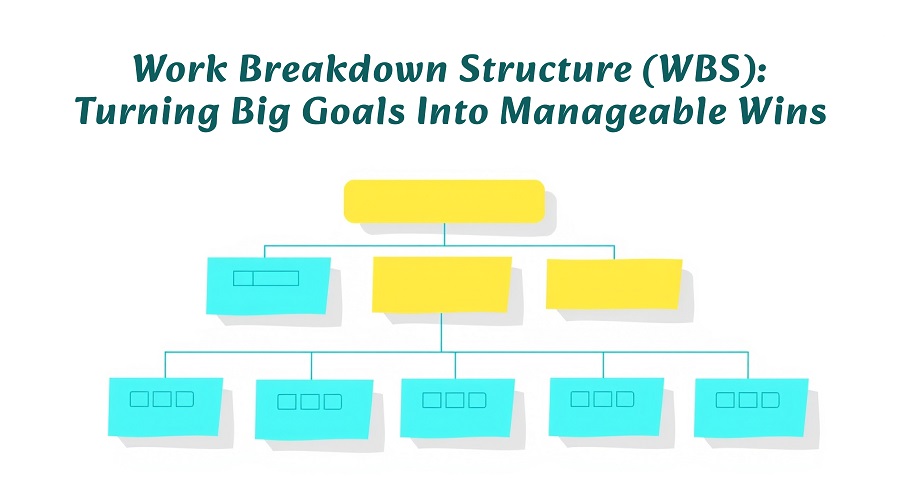
Big tasks or projects can feel daunting; you might wonder, “How am I supposed to start this?” You might think about product launches , special events, or even a thesis that you need to write and defend. Everything can feel overwhelmingly big until you remember that it can be broken into manageable steps.
This is what a Work Breakdown Structure (WBS) is for. You can think about a WBS as a big pizza (your project) that you can cut into bite-sized pieces. You don’t eat a whole pizza; you eat one piece at a time. Why don’t we find out why WBS is a project manager’s best kept secret, and how it can be used to bring order, clarity, and confidence into any project you decide to work on.
What Is a Work Breakdown Structure?
The Work Breakdown Structure simplifies how you view a project. The Project Management Institute (PMI) defines a WBS as “a hierarchical decomposition of the total scope of work to accomplish project objectives and create deliverables. ”
To illustrate WBS, think of a tree.
• The trunk of the tree represents the project goal.
• The branches of the tree represent the deliverables.
• The twigs of the tree represent the individual tasks that contribute to the branches.
This allows you to appreciate the order of execution and the interdependencies of tasks.
Why WBS Matters More Than You Think
Most project failures stem from weak planning, not poor execution. Since 2023, the Project Management Institute even suggests that having defined project outlines increases the chances of on-time and under-budget completions by 40%.
WBS deliverables systems help you:
- Prevent overlap and disarray.
- Clarify team member duties.
- Enhance scheduling and resource distribution.
- Minimize the frantic final rush.
Think of it as a way to remove clutter before the project starts.
Building a Work Breakdown Structure (Step-by-Step)
Consider that you are running a marketing campaign. In this case, this is how you would construct your WBS:
Define the Goal — Example: Launch a digital marketing campaign for a new product.
• Identify Major Deliverables — Market research, content creation, social media management, and ad campaigns.
• Break Each Deliverable Down -
i. Content creation → blog posts, graphics, video ads.
ii. Social media → scheduling, engagement, analytics.
• Assign Responsibilities — Decide who handles what and by when
• Review & Refine — Get feedback from your team to ensure nothing’s missing.
• And a simple rule — if a task is too complex to estimate or assign, break it down further.
Real-World Example: NASA and WBS
When planning the Apollo Program, NASA didn’t think, “Let’s go to the moon.” They addressed the mission in detail– launch operations, the training of astronauts, the design of the spacecraft, even the press and the communications. Each level of the Work Breakdown Structure (WBS) was fine-tuned and detailed down to every screw, line of code, and checklist so that everything had a clear owner.
That is how the seemingly impossible becomes possible. If the WBS can help take people to the moon, it can help you complete your next big project!
Expert Tip: The 100% Rule
One of the rules that must be followed when constructing the WBS: Every level needs to be 100% of the work. You cannot leave work and you cannot double your work. You must ratio the entire work of the deliverable/outcome that you need to make. After finishing, the WBS will be your acceptance criteria, an entire illustration of the tasks that need to be completed in order to achieve success.
Conclusion
A Work Breakdown Structure is more than just a tool for project managers — it is a bridge between chaos and organization. By taking lofty and far-reaching goals and objectives and breaking them into smaller, more manageable goals and objectives, you bring structure, responsibility, and concentration to your team’s efforts. The next time a particularly difficult project is assigned to you, just relax, and grab your notepad (or one of the many apps available to you).
You will appreciate how rapidly ‘impossible’ ceases to exist. After all, it isn’t the volume of work that determines success. It’s the ability to see what to do next.
FAQs
1. What is the main purpose of a WBS?
The main purpose of a WBS is to simplify complex projects by breaking them into smaller, manageable parts. It helps you understand what needs to be done, when, and by whom. This structure ensures no task is overlooked, improving time, cost, and quality control.
2. How is WBS different from a project schedule?
WBS defines what work needs to be done, while a project schedule defines when it will be done. Think of WBS as the blueprint and the schedule as the timeline. You create the WBS first so your schedule is accurate and grounded in real tasks.
3. Can small teams or individuals use WBS?
Absolutely! You don’t need to be managing a billion-dollar project to use WBS. Whether you’re planning a wedding, writing a research paper, or launching a side hustle, WBS helps you organize tasks, reduce stress, and stay accountable.
4. What tools can I use to create a WBS?
You can start with simple tools like Excel, Miro, or Google Sheets, or use professional project management platforms like Asana, Trello, or Microsoft Project. The key is clarity, not complexity — even a whiteboard can do the job!
5. What are common mistakes in creating a WBS?
Common mistakes include making it too detailed (causing confusion), skipping deliverables, or mixing up tasks with goals. Another issue is creating a WBS and then never updating it — remember, it’s a living document that evolves with your project.
Comments