


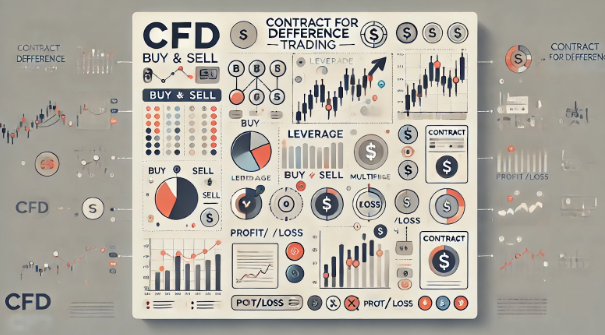
1. Introduction
In today’s financial markets, CFD trading (Contracts for Difference) has become an essential tool for many investors and traders. If you're looking for a flexible way to participate in global markets without actually owning the underlying assets, then CFD trading might be the perfect option for you.
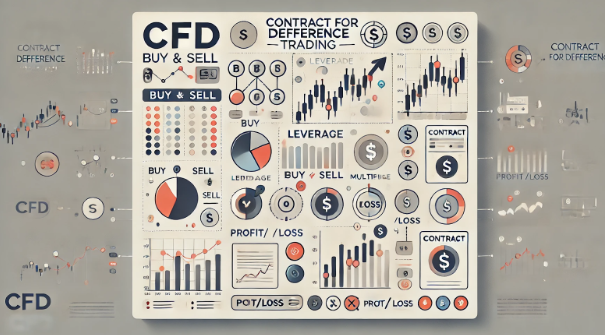
CFDs (Contracts for Difference) are financial derivatives that allow you to trade based on the price movements of an asset without owning the asset itself. In simple terms, a CFD allows you to speculate on the rise or fall of an asset’s price and profit or incur losses from these price changes, without having to buy or sell the actual stock, commodity, index, or any other underlying asset.
One of the key advantages of CFDs is the ability to use leverage. This means you can control a larger position with a smaller amount of capital, amplifying your potential profits (and, of course, the risks). For example, in the stock market, forex market, or even the cryptocurrency market, you can use CFDs to implement your trading strategies.
The popularity of CFD trading has grown due to its high flexibility and the variety of markets it offers. Whether it's forex, stocks, commodities, or cryptocurrencies, almost all major financial markets have CFD products available. CFDs allow investors to trade across different markets and even take short positions (i.e., profit when the market goes down), making it a sought-after tool for traders worldwide.
In this blog, you'll gain a complete understanding of what CFD trading is, how CFDs work, their advantages and risks, and how you can get started with CFD trading. We'll help you unravel the mysteries of CFDs and enable you to take full advantage of this tool in the global market.
2. What Are CFDs?
CFD (Contracts for Difference) is a contract that allows you to trade based on the price movements of an underlying asset, whether it is rising or falling. In simple terms, CFD trading enables you to profit from price fluctuations without actually owning the asset itself. Whether the market goes up or down, you can choose to buy or sell, and profit or incur losses based on market movements.
Difference from Traditional Stock Trading
Traditional stock trading requires you to buy or sell the actual stocks or assets. However, CFD trading is different; it is based on a contract that revolves around the "difference" in the asset's price. In CFD trading, you don't need to own the underlying asset. Instead, you speculate on its price movements. This makes CFD trading a highly flexible tool, especially for investors who want to react quickly to market changes and take advantage of leverage.
For example, in traditional stock trading, if you buy 100 shares of a company, you must pay for those 100 shares and take on the risk of holding them. But in CFD trading, you're merely trading based on the asset’s price movements, without owning or holding the actual stock. This flexibility makes CFD trading highly appealing to traders around the world.
Underlying Assets
One of the key features of CFDs is the variety of asset classes available for trading, including:
- Stocks: Stocks of well-known global companies (e.g., Apple, Google, etc.)
- Forex: Through forex CFDs, investors can trade on the price movements of currency pairs (e.g., EUR/USD, GBP/USD, etc.)
- Commodities: Prices of commodities like gold, oil, copper, etc.
- Indices: Market indices like the S&P 500, Dow Jones Industrial Average, etc.
With CFDs, traders have the ability to diversify across multiple markets, providing more investment opportunities. Whether it’s the volatility of global stock markets or the trends in forex and commodities, CFD trading opens up avenues for investors to capitalize on various market movements.
History of CFDs
The history of CFDs dates back to the early 1990s when they were first introduced in the financial markets of London. Initially, CFDs were created as a way to help institutional investors avoid capital gains tax on stock transactions and provide more flexibility in the market. Over time, CFD trading evolved into a globally recognized financial instrument, particularly among retail traders, and became an essential tool for accessing global markets.
Today, CFDs are widely used by investors across the globe, especially in the forex, stock, and commodity markets. Their popularity is not just due to their ease of use and access to diversified assets, but also because they offer leveraged trading, which attracts more and more traders every day.
3. How Do CFDs Work?
CFD trading works by predicting the price movement of an underlying asset, allowing you to profit from its fluctuations without actually owning the asset. You enter into a contract with a broker, agreeing to pay or receive the difference in the asset's price movement at the time the contract is closed.
Buying (Long) vs Selling (Short)
In CFD trading, you can choose to either buy or sell a contract depending on whether you think the market will rise or fall:
- Buying (Long): If you believe the market will rise, you would buy a CFD contract. This means you’ll profit from the price increase of the underlying asset.
- Selling (Short): If you believe the market will fall, you would sell a CFD contract, allowing you to profit from a decrease in the asset’s price.
This flexibility makes CFD trading more attractive than traditional stock trading because it allows you to potentially profit in both rising and falling markets.
Leverage Effect
A key feature of CFD trading is the use of leverage. Leverage allows you to control a larger position with a smaller amount of capital. Simply put, you can invest less money upfront and still gain exposure to a larger market position.
For example, with $1,000 in margin, you could control a $10,000 CFD contract, meaning you are controlling a position 10 times larger than your initial investment. While leverage can amplify your potential profits, it can also increase your potential losses, so it’s important to use leverage cautiously.
Example Illustration
Example 1: Stock CFD Trading
Let’s say you’re trading a stock CFD, and the current price is $100. You believe the stock price will rise in the next few days, so you decide to buy 1 CFD. If the price rises to $110, you can then choose to sell the CFD and make a profit of $10.
- Initial price: $100
- Buy: 1 CFD
- Sell: $110
- Price difference: $110 - $100 = $10
- Profit: $10 per contract
However, if the stock price drops to $90 instead, you would face a loss of $10 per contract.
- Initial price: $100
- Buy: 1 CFD
- Sell: $90
- Price difference: $90 - $100 = -$10
- Loss: $10 per contract
Example 2: Forex CFD Trading
Let’s say you’re trading the EUR/USD (Euro/US Dollar) forex pair’s CFD. The current price is 1.2000, meaning 1 Euro equals 1.2000 USD. You believe the USD will depreciate, so you decide to buy the CFD.
- Initial price: 1.2000
- Buy: 1 lot (100,000 Euros)
- Sell price: 1.2100
- Price difference: 1.2100 - 1.2000 = 0.0100
- Profit: Each point (0.0001) equals $10, so 100 points equals $1,000 profit.
If the USD strengthens instead, you would choose to sell, incurring a loss. For example, if the EUR/USD drops to 1.1900, you would lose $10 per point, totaling a $1,000 loss (100 points difference).
Example 3: Commodity CFD Trading
You can also trade commodities like gold via CFDs. Let’s say the spot price of gold is $1,800 per ounce, and you believe gold prices will rise, so you decide to buy 1 CFD.
- Initial price: $1,800 per ounce
- Buy: 1 CFD
- Sell price: $1,820 per ounce
- Price difference: $1,820 - $1,800 = $20 per ounce
- Profit: $20 per ounce
On the other hand, if the gold price falls to $1,780 per ounce, you would face a $20 per ounce loss.
Example 4: Index CFD Trading
Let’s say you’re trading a S&P 500 index CFD. The current price of the S&P 500 index is 4,000 points, and you believe the index will rise, so you decide to buy 1 CFD.
- Initial price: 4,000 points
- Buy: 1 CFD
- Sell price: 4,100 points
- Price difference: 4,100 - 4,000 = 100 points
- Profit: $10 per point, so 100 points equals a $1,000 profit
If the market reverses, and the S&P 500 drops to 3,900 points, you would incur a loss.
- Initial price: 4,000 points
- Buy: 1 CFD
- Sell price: 3,900 points
- Price difference: 3,900 - 4,000 = -100 points
- Loss: $10 per point, so 100 points equals a $1,000 loss
Through these different market CFD examples, you can see that whether it’s stocks, forex, commodities, or indices, you can trade based on price fluctuations. Both leverage and margin requirements magnify your profits and losses. Therefore, effective risk management is crucial when trading CFDs.
Margin Requirement
In CFD trading, you are usually required to put up a margin as the in
For more info :-
Comments