


- Abuse & The Abuser
- Achievement
- Activity, Fitness & Sport
- Aging & Maturity
- Altruism & Kindness
- Atrocities, Racism & Inequality
- Challenges & Pitfalls
- Choices & Decisions
- Communication Skills
- Crime & Punishment
- Dangerous Situations
- Dealing with Addictions
- Debatable Issues & Moral Questions
- Determination & Achievement
- Diet & Nutrition
- Employment & Career
- Ethical dilemmas
- Experience & Adventure
- Faith, Something to Believe in
- Fears & Phobias
- Friends & Acquaintances
- Habits. Good & Bad
- Honour & Respect
- Human Nature
- Image & Uniqueness
- Immediate Family Relations
- Influence & Negotiation
- Interdependence & Independence
- Life's Big Questions
- Love, Dating & Marriage
- Manners & Etiquette
- Money & Finances
- Moods & Emotions
- Other Beneficial Approaches
- Other Relationships
- Overall health
- Passions & Strengths
- Peace & Forgiveness
- Personal Change
- Personal Development
- Politics & Governance
- Positive & Negative Attitudes
- Rights & Freedom
- Self Harm & Self Sabotage
- Sexual Preferences
- Sexual Relations
- Sins
- Thanks & Gratitude
- The Legacy We Leave
- The Search for Happiness
- Time. Past, present & Future
- Today's World, Projecting Tomorrow
- Truth & Character
- Unattractive Qualities
- Wisdom & Knowledge






FOLLOWERS
0
Users
Truth & Character Thursdays
Disliking Yourself
“You can’t get healthy by hating yourself.” This thought has been rolling around in my head for the past few years because the more I think about it, the more truth it seems to hold.
I’m not just talking about physical health either - I’m talking about mental, emotional, spiritual, and physical health. Our holistic beings cannot find health through hating or disliking ourselves.
Sure, we can lose weight or change the way that we look through disdain or dislike for ourselves. Look at many fad diets out there where people punish themselves through restriction and deprivation because they dislike themselves so much. The trouble with this is that if we don’t do the inner work to address the root causes of that self-dislike, the changes are rarely permanent or healthy. The core issue remains, and it usually sabotages the progress eventually.
The pursuit of health—in any form—should be driven by self-respect, not self-loathing. You get fit because you value your body, not because you despise its current state. You work on your mental health because you deserve peace, not because you hate the anxiety.
When you operate from a place of self-dislike, your actions are punishments. They are fueled by negative emotions: guilt, shame, and a desperate need for external validation or conformity.
We are all unique, and trying to force yourself into a mold of someone else’s making will only increase your self-dislike. Embrace your uniqueness, focus on self-compassion, and recognize that you are worthy of health and happiness right now, regardless of your current circumstances or appearance. True, lasting health begins with acceptance.
Interesting Fact #1
None of us are born hating ourselves – we learn how to do it, which means it’s something we can unlearn.
Interesting Fact #2
Once you begin to recognize signs that you hate yourself, you can start to work on them. Acknowledging self-hate is the first step toward liberating ourselves from its grip
Interesting Fact #3
When we are the subject of our own resentment, we can quickly become the scapegoat for everything that feels wrong in our lives.

Quote of the day
“Life is too short to waste any amount of time on wondering what other people think about you. In the first place, if they had better things going on in their lives, they wouldn't have the time to sit around and talk about you. What's important to me is not others' opinions of me, but what's important to me is my opinion of myself.” ― C. JoyBell C.
Article of the day - Self-Loathing
Self-loathing is a negative self-view that makes you believe you aren’t good enough. It can affect your relationships, school or work performance and ability to sleep well. Negative thoughts usually make you feel worse, which cycles into more negative thoughts. A mental health professional can help you adjust your thinking so you feel better.
Overview
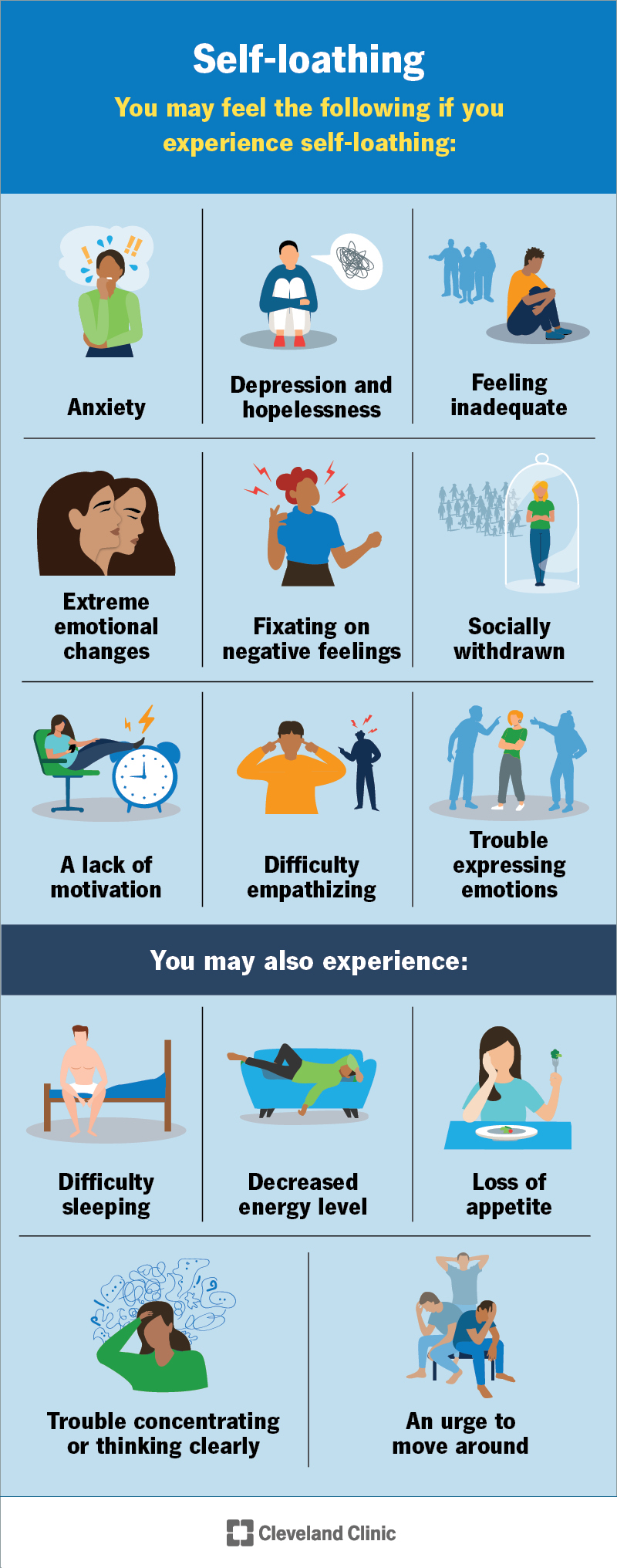
Self-loathing can affect your mood and behavior.
What is self-loathing?
Self-loathing is a strong feeling that you’re not good enough. It resembles self-hate.
With self-loathing, you might over-criticize the way you look or the things that you do. You may notice all of your flaws or mistakes and put yourself down because of them. You may feel unworthy, worthless or imperfect.
Self-loathing makes it difficult to see the positives and the good parts of every moment when your mind focuses on the negatives.
Experiencing self-loathing doesn’t mean you’re a bad person or incapable of feeling good about yourself. It just means that your brain is wired to think differently. There are ways that you can rewire your brain. Sometimes, this is challenging to do, so don’t hesitate to reach out to a healthcare provider. They can help you rearrange those wires so you can feel better.
Signs and symptoms of self-loathing
You may feel the following if you experience self-loathing:
- Anxiety
- Depression and hopelessness
- Fixating on negative feelings (rumination)
- Feeling inadequate
- A lack of motivation
- Socially withdrawn
- Extreme emotional changes (emotional liability)
- Difficulty empathizing with others (emotional rigidity)
- Trouble expressing emotions (blunted effect)
Self-loathing may affect your behavior. It could reduce your motivation so you’re less likely to carry out positive behaviors. For example, you may feel like there’s no point in pursuing a promotion at work. Or you might avoid self-care because of negative thoughts.
You may also experience:
- Difficulty sleeping (not falling asleep, waking up early, sleep interruptions, insomnia)
- Trouble concentrating or thinking clearly
- Decreased energy level
- Loss of appetite or eating more than usual
- An urge to move around (motor restlessness)
What does self-loathing look like?
Self-loathing may look and feel different for each person who experiences it. The most common features include:
- No self-compassion
- Extreme self-criticism
- A lack of trust or respect for yourself
- Feeling stressed out often
Your thoughts could be overwhelming. Some examples of self-loathing thoughts may include:
- “I won’t do well on this.”
- “I look awful.”
- “I don’t deserve this.”
Negative thoughts and feelings typically happen in a cycle. As negative thoughts continue, it makes you feel bad. This contributes to more negativity.
Is self-loathing a mental illness?
No. But self-loathing may be a symptom of many underlying mental health conditions. The most common condition is depression.
Possible Causes
What causes self-loathing?
There are a lot of factors that may contribute to self-loathing. It typically develops over time. Some examples of what may cause self-loathing may include:
- An underlying mental health condition, like depression or anxiety, among others
- Adverse childhood experiences or traumatic life events
- Wanting to fit in or comparing yourself to others (societal expectations)
- Having very high standards for yourself (perfectionism)
- Low self-esteem
Care and Treatment
How to stop self-loathing?
Self-loathing can be challenging to manage on your own. You can talk to a mental health professional who can help you work through these difficult thoughts and feelings. They may recommend participating in cognitive behavioral therapy. This is a type of talk therapy where you’ll learn more about how your thoughts and feelings affect your behavior so you can take steps to address them.
Everyone can benefit from therapy, and it isn’t a sign of weakness or failure. Instead, it’s a sign of strength and wanting to take care of yourself.
Tips to stop self-loathing
It takes time and practice to interrupt the cycle of negative thoughts and feelings. Here are some tips that may help:
- Do activities that remind you of positive experiences and distract you from negative ones.
- Try to recall a time when things worked out well while doing a similar task.
- Make changes to your environment that help you remember good times, like hanging a photo of your loved ones on your mirror.
- Find ways to make big problems easier, like taking them one step at a time instead of doing everything at once.
- Focus on your progress instead of the outcome, like finishing the race instead of winning first place.
One way to deal with self-loathing is to approach the critic. You can imagine self-loathing as a very opinionated critic in your head. They have something not-so-nice to say about everything you do. But have you tried talking to them? You can try the following:
- Say the negative thought out loud.
- Ask yourself if this is something you’d tell another person.
- If you answer “no,” can you think of another way to phrase this thought to be more constructive or helpful?
When you talk to the critic, you can practice different ways to talk to yourself to manage negative thoughts. This gives you more insight into how often you may be unfair or unkind to yourself. It opens the door to allow yourself some compassion and empathy.
When To Call the Doctor
When should I see a healthcare provider about self-loathing?
Having occasional negative self-thoughts is normal. But if these thoughts become overwhelming, distracting or prevent you from completing your routine, it’s time to talk to a healthcare provider.
Here are some examples of when you should get help for self-loathing:
- Your eating habits change.
- It impacts your grades in school or your work performance.
- Your sleeping patterns change.
- You frequently use the phrase “I don’t feel well” without physical symptoms to get out of personal obligations.
Self-loathing thoughts may lead to other thoughts about suicide or self-harm. If you start to have these thoughts, you’re not alone — and help is available. You can reach out to a healthcare provider or call or text 988. This is the Suicide & Crisis Lifeline. Someone is available to talk to you 24/7. If you’re in immediate danger, contact 911 or your local emergency services number.
A note from Cleveland Clinic
It’s common not to like every part of who you are. But if your dislikes outweigh your likes by a long shot, it’s time to talk to someone about them.
Self-loathing can be difficult to manage when you face it alone. But you don’t have to do it on your own. A healthcare provider can help when you’re ready. It’ll be challenging to adjust your pattern of thinking. And the results need time to develop. But many people can turn negative thoughts into positive ones. So, don’t give up hope if you’re managing self-loathing.
Question of the day - What is one small act of self-compassion you can practice today, instead of self-criticism?
Image & Uniqueness
What is one small act of self-compassion you can practice today, instead of self-criticism?
Daily archives
Current Survey
Top 5 Contributors (Mar)

20209 pts

12060 pts

10714 pts

10417 pts

10117 pts