


- Abuse & The Abuser
- Achievement
- Activity, Fitness & Sport
- Aging & Maturity
- Altruism & Kindness
- Atrocities, Racism & Inequality
- Challenges & Pitfalls
- Choices & Decisions
- Communication Skills
- Crime & Punishment
- Dangerous Situations
- Dealing with Addictions
- Debatable Issues & Moral Questions
- Determination & Achievement
- Diet & Nutrition
- Employment & Career
- Ethical dilemmas
- Experience & Adventure
- Faith, Something to Believe in
- Fears & Phobias
- Friends & Acquaintances
- Habits. Good & Bad
- Honour & Respect
- Human Nature
- Image & Uniqueness
- Immediate Family Relations
- Influence & Negotiation
- Interdependence & Independence
- Life's Big Questions
- Love, Dating & Marriage
- Manners & Etiquette
- Money & Finances
- Moods & Emotions
- Other Beneficial Approaches
- Other Relationships
- Overall health
- Passions & Strengths
- Peace & Forgiveness
- Personal Change
- Personal Development
- Politics & Governance
- Positive & Negative Attitudes
- Rights & Freedom
- Self Harm & Self Sabotage
- Sexual Preferences
- Sexual Relations
- Sins
- Thanks & Gratitude
- The Legacy We Leave
- The Search for Happiness
- Time. Past, present & Future
- Today's World, Projecting Tomorrow
- Truth & Character
- Unattractive Qualities
- Wisdom & Knowledge






FOLLOWERS
0
Users
Outlooks & Setbacks Saturdays
Conflict Resolutions
If you are in the midst of a big conflict, you might be searching for conflict resolution skills. In the heat of the moment, sometimes it can be so important to have a process to follow to resolve a difficult situation.
Today I thought I would share my favorite conflict resolution process.
-
Clearly identify the conflict. Sometimes putting language to what the conflict is about is challenging. It lays it out on the table clearly so that all parties clearly understand the issue at hand. Sometimes we are afraid to define the problem because it calls it out loud and clear and that can be uncomfortable. But until a problem is clear, it is difficult to resolve.
-
Set a neutral location to discuss. If one person feels that they hold the power in a conflict, it makes for an unfair resolution. Meet somewhere neutral so that the location does not give either side a leg up.
-
Define the goal. Is your goal simply to be right or get your way? Or is the goal to restore a relationship? What are you trying to achieve with the conflict resolution - sometimes we forget that being right might feel good in the moment but it’s not actually the outcome we want in the end at the expense of the relationship.
-
Understand the other person’s perspective. This is the part that I like to call negotiating in good faith. That means that you are looking for a mutually beneficial outcome - you’re not just looking out for yourself. A big part of doing this successfully is learning to understand the other person’s perspective.
-
Implement. This is when you actually execute the outcome that was mutually agreed upon. Remember that at this stage it’s important to continue to respect the other person and not to gloat if the outcome is more heavily favored your way.
So that’s it - it’s one of those simple but not easy processes! What aspect of conflict resolution do you struggle with the most?
Interesting Fact #1
Personality conflict or disagreements between individuals. These clashes are driven and perpetuated by emotions such as anger, stress and frustration.
Interesting Fact #2
Substantive conflict is tangible and task-related, like the decisions leaders make, the performance of a team member, or your company's direction.
Interesting Fact #3
Conflict resolution can be defined as the process of identifying, addressing, and resolving disagreements or disputes among employees in a professional setting, thereby fostering a positive and productive work environment.
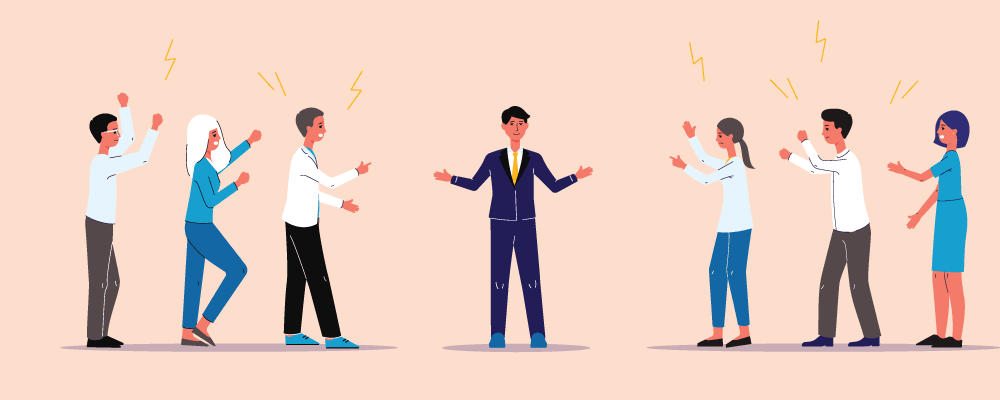
Quote of the day
“We don't get harmony when everybody sings the same note. Only notes that are different can harmonize. The same is true with people.” ― Steve Goodier
Article of the day - Conflict Resolution Skills
What is conflict?
Conflict is a normal part of any healthy relationship. After all, two people can’t be expected to agree on everything, all the time. The key is not to fear or try to avoid conflict but to learn how to resolve it in a healthy way.
When conflict is mismanaged, it can cause great harm to a relationship, but when handled in a respectful, positive way, conflict provides an opportunity to strengthen the bond between two people. Whether you’re experiencing conflict at home, work, or school, learning these skills can help you resolve differences in a healthy way and build stronger, more rewarding relationships.
Conflict 101
- A conflict is more than just a disagreement. It is a situation in which one or both parties perceive a threat (whether or not the threat is real).
- Conflicts continue to fester when ignored. Because conflicts involve perceived threats to our well-being and survival, they stay with us until we face and resolve them.
- We respond to conflicts based on our perceptions of the situation, not necessarily to an objective review of the facts. Our perceptions are influenced by our life experiences, culture, values, and beliefs.
- Conflicts trigger strong emotions. If you aren't comfortable with your emotions or able to manage them in times of stress, you won't be able to resolve conflict successfully.
- Conflicts are an opportunity for growth. When you're able to resolve conflict in a relationship, it builds trust. You can feel secure knowing your relationship can survive challenges and disagreements.
Causes of conflict in a relationship
Conflict arises from differences, both large and small. It occurs whenever people disagree over their values, motivations, perceptions, ideas, or desires. Sometimes these differences appear trivial, but when a conflict triggers strong feelings, a deep personal need is often at the core of the problem. These needs can range from the need to feel safe and secure or respected and valued, to the need for greater closeness and intimacy.
Think about the opposing needs of a toddler and a parent. The child’s need is to explore, so venturing to the street or the cliff edge meets that need. But the parent's need is to protect the child’s safety, a need that can only be met by limiting the toddler’s exploration. Since these needs are at odds, conflict arises.
The needs of each party play an important role in the long-term success of a relationship. Each deserves respect and consideration. In personal relationships, a lack of understanding about differing needs can result in distance, arguments, and break-ups. In the workplace, differing needs can result in broken deals, decreased profits, and lost jobs.
[Read: Tips for Building a Healthy Relationship]
When you can recognize conflicting needs and are willing to examine them with compassion and understanding, it can lead to creative problem solving, team building, and stronger relationships.
How do you respond to conflict?
Do you fear conflict or avoid it at all costs? If your perception of conflict comes from painful memories from early childhood or previous unhealthy relationships, you may expect all disagreements to end badly. You may view conflict as demoralizing, humiliating, or something to fear. If your early life experiences left you feeling powerless or out of control, conflict may even be traumatizing for you.
If you're afraid of conflict, it can become a self-fulfilling prophecy. When you enter a conflict situation already feeling threatened, it's tough to deal with the problem at hand in a healthy way. Instead, you're more likely to either shut down or blow up in anger.
| Healthy and unhealthy ways of managing and resolving conflict | |
| Unhealthy responses to conflict: | Healthy responses to conflict: |
| An inability to recognize and respond to the things that matter to the other person. | The capacity to empathize with the other person's viewpoint. |
| Explosive, angry, hurtful, and resentful reactions. | Calm, non-defensive, and respectful reactions. |
| The withdrawal of love, resulting in rejection, isolation, shaming, and fear of abandonment. | A readiness to forgive and forget, and to move past the conflict without holding resentments or anger. |
| An inability to compromise or see the other person's side. | The ability to seek compromise and avoid punishing. |
| Feeling fearful or avoiding conflict; expecting a bad outcome. | A belief that facing conflict head on is the best thing for both sides. |
Conflict resolution, stress, and emotions
Conflict triggers strong emotions and can lead to hurt feelings, disappointment, and discomfort. When handled in an unhealthy manner, it can cause irreparable rifts, resentments, and break-ups. But when conflict is resolved in a healthy way, it increases your understanding of the other person, builds trust, and strengthens your relationships.
If you are out of touch with your feelings or so stressed that you can only pay attention to a limited number of emotions, you won't be able to understand your own needs. This will make it hard to communicate with others and establish what's really troubling you. For example, couples often argue about petty differences—the way she hangs the towels, the way he slurps his soup—rather than what is really bothering them.
The ability to successfully resolve conflict depends on your ability to:
- Manage stress quickly while remaining alert and calm. By staying calm, you can accurately read and interpret verbal and nonverbal communication.
- Control your emotions and behavior. When you're in control of your emotions, you can communicate your needs without threatening, intimidating, or punishing others.
- Pay attention to the feelings being expressed as well as the spoken words of others.
- Be aware of and respect differences. By avoiding disrespectful words and actions, you can almost always resolve a problem faster.
To successfully resolve a conflict, you need to learn and practice two core skills:
- Quick stress relief: the ability to quickly relieve stress in the moment.
- Emotional awareness: the ability to remain comfortable enough with your emotions to react in constructive ways, even in the midst of a perceived attack.
Core skill 1: Quick stress relief
Being able to manage and relieve stress in the moment is the key to staying balanced, focused, and in control, no matter what challenges you face. If you don't know how to stay centered and in control of yourself, you will become overwhelmed in conflict situations and unable to respond in healthy ways.
Psychologist Connie Lillas uses a driving analogy to describe the three most common ways people respond when they're overwhelmed by stress:
Foot on the gas. An angry or agitated stress response. You're heated, keyed up, overly emotional, and unable to sit still.
Foot on the brake. A withdrawn or depressed stress response. You shut down, space out, and show very little energy or emotion.
Foot on both gas and brake. A tense and frozen stress response. You “freeze” under pressure and can't do anything. You look paralyzed, but under the surface you're extremely agitated.
How stress affects conflict resolution
Stress interferes with the ability to resolve conflict by limiting your ability to:
- Accurately read another person's body language.
- Hear what someone is really saying.
- Be aware of your own feelings.
- Be in touch with your own, deep-rooted needs.
- Communicate your needs clearly.
Is stress a problem for you?
You may be so used to feeling stressed that you're not even aware you are stressed. Stress may pose a problem in your life if you identify with the following:
- You often feel tense or tight somewhere in your body.
- You're not aware of movement in your chest or stomach when you breathe.
- Conflict absorbs your time and attention.
Learn how to manage stress in the moment
One of the most reliable ways to rapidly reduce stress is by engaging one or more of your senses—sight, sound, taste, smell, touch—or through movement. You could squeeze a stress ball, smell a relaxing scent, taste a soothing cup of tea, or look at a treasured photograph. We all tend to respond differently to sensory input, often depending on how we respond to stress, so take some time to find things that are soothing to you. Read: Quick Stress Relief.
Core skill 2: Emotional awareness
Emotional awareness is the key to understanding yourself and others. If you don't know how or why you feel a certain way, you won't be able to communicate effectively or resolve disagreements.
[Read: Improving Emotional Intelligence]
Although knowing your own feelings may sound simple, many people ignore or try to sedate strong emotions like anger, sadness, and fear. Your ability to handle conflict, however, depends on being connected to these feelings. If you're afraid of strong emotions or if you insist on finding solutions that are strictly rational, your ability to face and resolve differences will be limited.
Why emotional awareness is a key factor in resolving conflict
Emotional awareness—the consciousness of your moment-to-moment emotional experience—and the ability to manage all of your feelings appropriately, is the basis of a communication process that can resolve conflict.
Emotional awareness helps you to:
- Understand what is really troubling other people
- Understand yourself, including what is really troubling you
- Stay motivated until the conflict is resolved
- Communicate clearly and effectively
- Interest and influence others
Assessing your level of emotional awareness
The following quiz helps you assess your level of emotional awareness. Answer the following questions with: almost never, occasionally, often, very often, or almost always. There are no right or wrong responses, only the opportunity to become better acquainted with your emotional responses.
What kind of relationship do you have with your emotions?
- Do you experience feelings that flow, encountering one emotion after another as your experiences change from moment to moment?
- Are your emotions accompanied by physical sensations that you experience in places like your stomach or chest?
- Do you experience distinct feelings and emotions, such as anger, sadness, fear, and joy, which are evident in different facial expressions?
- Can you experience intense feelings that are strong enough to capture both your own attention and that of others?
- Do you pay attention to your emotions? Do they factor into your decision-making?
If any of these experiences are unfamiliar, your emotions may be “turned” down or even off. In either case, you may need help developing your emotional awareness. You can do this by using Helpguide's free Emotional Intelligence Toolkit.
Nonverbal communication and conflict resolution
When people are in the middle of a conflict, the words they use rarely convey the issues at the heart of the problem. But by paying close attention to the other person's nonverbal signals or “body language,” such as facial expressions, posture, gestures, and tone of voice, you can better understand what the person is really saying. This will allow you to respond in a way that builds trust, and gets to the root of the problem.
[Read: Nonverbal Communication and Body Language]
Your ability to accurately read another person depends on your own emotional awareness. The more aware you are of your own emotions, the easier it will be for you to pick up on the wordless clues that reveal what others are feeling. Think about what you are transmitting to others during conflict, and if what you say matches your body language. If you say “I'm fine,” but you clench your teeth and look away, then your body is clearly signaling you are anything but “fine.” A calm tone of voice, a reassuring touch, or an interested facial expression can go a long way toward relaxing a tense exchange.
More tips for managing and resolving conflict
You can ensure that the process of managing and resolving conflict is as positive as possible by sticking to the following guidelines:
Listen for what is felt as well as said. When you really listen, you connect more deeply to your own needs and emotions, and to those of other people. Listening also strengthens, informs, and makes it easier for others to hear you when it's your turn to speak.
Make conflict resolution the priority rather than winning or “being right.” Maintaining and strengthening the relationship, rather than “winning” the argument, should always be your first priority. Be respectful of the other person and their viewpoint.
Focus on the present. If you're holding on to grudges based on past conflicts, your ability to see the reality of the current situation will be impaired. Rather than looking to the past and assigning blame, focus on what you can do in the here-and-now to solve the problem.
Pick your battles. Conflicts can be draining, so it's important to consider whether the issue is really worth your time and energy. Maybe you don't want to surrender a parking space if you've been circling for 15 minutes, but if there are dozens of empty spots, arguing over a single space isn't worth it.
Be willing to forgive. Resolving conflict is impossible if you're unwilling or unable to forgive others. Resolution lies in releasing the urge to punish, which can serve only to deplete and drain your life.
Know when to let something go. If you can't come to an agreement, agree to disagree. It takes two people to keep an argument going. If a conflict is going nowhere, you can choose to disengage and move on.
Using humor in conflict resolution
You can avoid many confrontations and resolve arguments and disagreements by communicating in a humorous way. Humor can help you say things that might otherwise be difficult to express without offending someone. However, it's important that you laugh with the other person, not at them. When humor and play are used to reduce tension and anger, reframe problems, and put the situation into perspective, the conflict can actually become an opportunity for greater connection and intimacy.
Question of the day - What aspect of conflict resolution do you struggle with the most?
Determination & Achievement
What aspect of conflict resolution do you struggle with the most?
Daily archives
Current Survey
Top 5 Contributors (Jun)

20209 pts

12060 pts

10714 pts

10417 pts

10117 pts