




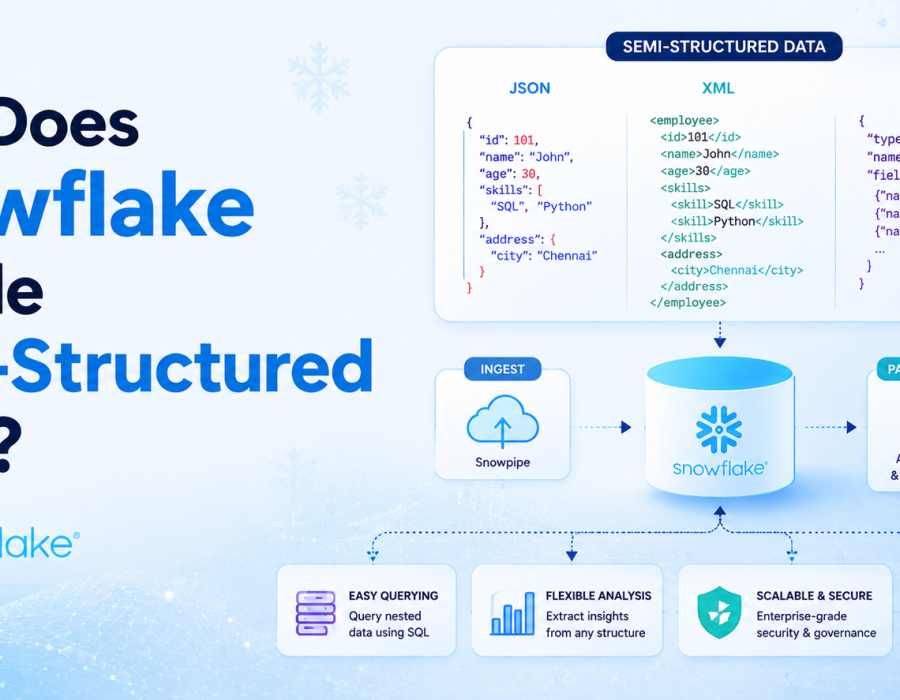
Modern applications generate data in many different formats. Not everything arrives as a neat table with fixed rows and columns. Websites, mobile applications, APIs, IoT devices, and business systems often produce information in formats such as JSON, XML, and Avro. Managing this kind of flexible data can be challenging with traditional relational databases. Snowflake makes the process easier by providing built-in capabilities for storing, querying, and transforming semi-structured information. For professionals building modern data engineering skills, Snowflake Training in Chennai can help develop practical knowledge of how semi-structured data fits into cloud data platforms.
What Is Semi-Structured Data?
Before looking at how Snowflake handles it, let's understand what semi-structured data actually means.
Structured data follows a predefined format. A traditional relational table is a good example:
Customer ID
Name
City
101
Arun
Chennai
102
Priya
Coimbatore
Every record follows the same basic structure.
Semi-structured data is more flexible. It may contain fields, nested objects, arrays, and different structures within the same dataset.
A simple JSON record might look like this:
{
"customer_id": 101,
"name": "Arun",
"city": "Chennai",
"orders": [
{
"product": "Laptop",
"price": 65000
}
]
}
Notice that the orders field contains another structure inside the main record. This kind of nested information is common in modern applications.
Why Is Semi-Structured Data Important?
Businesses generate semi-structured data constantly.
For example:
- APIs return JSON responses.
- Web applications generate event data.
- IoT devices produce sensor information.
- Mobile applications send activity data.
- Cloud services generate logs.
- E-commerce platforms capture customer and order events.
Trying to convert all of this information into traditional relational tables before storing it can make data pipelines complicated.
Snowflake allows organizations to work with many semi-structured formats without forcing everything into a rigid relational structure immediately.
Snowflake VARIANT Data Type
One of the most important features for handling semi-structured data in Snowflake is the VARIANT data type.
VARIANT can store values containing different types of semi-structured data, including JSON, Avro, and other supported formats.
For example, a table could contain a VARIANT column called customer_data.
CREATE TABLE customers (
customer_id INT,
customer_data VARIANT
);
The customer_data column can hold a JSON document rather than a traditional fixed set of columns.
This gives data engineers more flexibility when dealing with data whose structure may change over time.
Storing JSON Data in Snowflake
JSON is one of the most common semi-structured formats used by applications and APIs.
Snowflake allows JSON documents to be loaded into tables and stored using the VARIANT data type.
Once the data is available, engineers can query individual fields directly.
For example:
SELECT customer_data:name
FROM customers;
Here, the colon notation allows the query to access a specific field inside the semi-structured object.
If the JSON contains nested information, engineers can navigate through the structure using additional path expressions.
This means there is no need to flatten every JSON document before querying it.
Querying Nested Data
One of the useful aspects of Snowflake's semi-structured data support is the ability to access nested fields.
Suppose a JSON document contains:
{
"customer": {
"name": "Arun",
"location": {
"city": "Chennai"
}
}
}
You can navigate through the nested structure to retrieve the city.
The ability to work directly with nested data can make exploration much easier, especially when engineers are working with large API responses or event records.
Working with Arrays
Semi-structured data frequently contains arrays.
For example:
{
"customer": "Arun",
"products": [
"Laptop",
"Monitor",
"Keyboard"
]
}
If you need to work with each array element as an individual row, Snowflake provides the FLATTEN table function.
FLATTEN can expand elements from arrays or objects into separate rows.
This becomes particularly useful when transforming nested JSON into a relational structure for reporting or analytics.
A simplified example is:
SELECT
customer_data:customer,
product.value
FROM customers,
LATERAL FLATTEN(input => customer_data:products) product;
Instead of manually processing the JSON outside Snowflake, engineers can perform the transformation within the platform.
Snowflake File Formats for Semi-Structured Data
Snowflake supports several file formats commonly used for semi-structured data.
These include:
- JSON
- Avro
- Parquet
- ORC
Data engineers can define file formats and use stages to load data into Snowflake.
For example, an organization might receive JSON files from an application every few minutes. These files can be placed in cloud storage and then loaded into Snowflake for further processing.
This creates a flexible pipeline for handling application-generated data.
Schema-on-Read Approach
Traditional relational systems often encourage defining the table structure before loading the data.
With semi-structured data, Snowflake provides more flexibility by allowing engineers to store the original structure and extract fields when they are needed.
This is often associated with a schema-on-read approach.
For example, an engineering team may receive JSON documents with fields that change occasionally. Instead of redesigning a relational table every time a new attribute appears, they can retain the JSON structure and query the required fields.
This can make evolving data sources easier to manage.
Combining Structured and Semi-Structured Data
Another major advantage is that Snowflake does not force organizations to choose between structured and semi-structured data.
A table can contain traditional relational columns alongside a VARIANT column.
For example:
CREATE TABLE orders (
order_id INT,
order_date DATE,
customer_data VARIANT
);
Here, important fields such as order_id and order_date can remain structured, while flexible customer information can be stored in the VARIANT column.
This hybrid approach can be useful when organizations need both predictable reporting fields and flexible source data.
Benefits of Handling Semi-Structured Data in Snowflake
Snowflake's support for semi-structured data provides several practical benefits.
Flexibility: Data does not always need to follow a rigid structure.
Simpler ingestion: JSON and other supported formats can be loaded without extensive preprocessing.
Direct querying: Engineers can query nested fields using SQL.
Easy transformation: Functions such as FLATTEN help convert nested structures into relational formats.
Scalability: Snowflake can support large volumes of data without requiring traditional database infrastructure management.
Hybrid data models: Structured and semi-structured information can coexist within the same platform.
Common Use Cases
Semi-structured data handling is useful across many industries.
An e-commerce company can store customer activity and product events in JSON.
A financial organization can process API-generated transaction information.
IoT platforms can capture sensor readings containing varying attributes.
Marketing teams can analyze web and application event data.
Data engineering teams can also use semi-structured storage as an intermediate layer before transforming information into curated analytical tables.
Final Thoughts
Semi-structured data has become a normal part of modern data engineering. Instead of forcing JSON, Avro, Parquet, or other flexible data into rigid structures immediately, Snowflake provides tools that allow engineers to store and work with this information more naturally.
Features such as VARIANT, FLATTEN, nested field access, and support for common semi-structured file formats make Snowflake suitable for workloads where data structures can evolve over time.
The real advantage comes from combining this flexibility with SQL, allowing data engineers to explore and transform complex data without relying entirely on external processing tools.
For learners who want to build practical cloud data engineering skills, Qmatrix Technologies can provide hands-on exposure to Snowflake concepts, including semi-structured data, SQL, data transformation, and real-world pipeline development.
Comments