





Let’s start in the middle of the problem. Your team needs to build something truly AI-native and development-focused. An application where artificial intelligence is the core mechanism, the primary engine of the experience. That demand changes your technological decisions when evaluating modern AI coding tools. It makes your platform choice a profoundly strategic decision.
You are choosing a development philosophy that will shape your team’s output, pace, and possibilities when you build apps with AI. This conversation compares two compelling paths forward in this Lovable vs Replit comparison: Lovable and Replit. We will move beyond features to examine their inherent trade-offs between speed and control, abstraction and ownership. The right answer depends entirely on what you are building and who is building it.
Modern Dev Thinking: AI Assistance vs AI IDEs
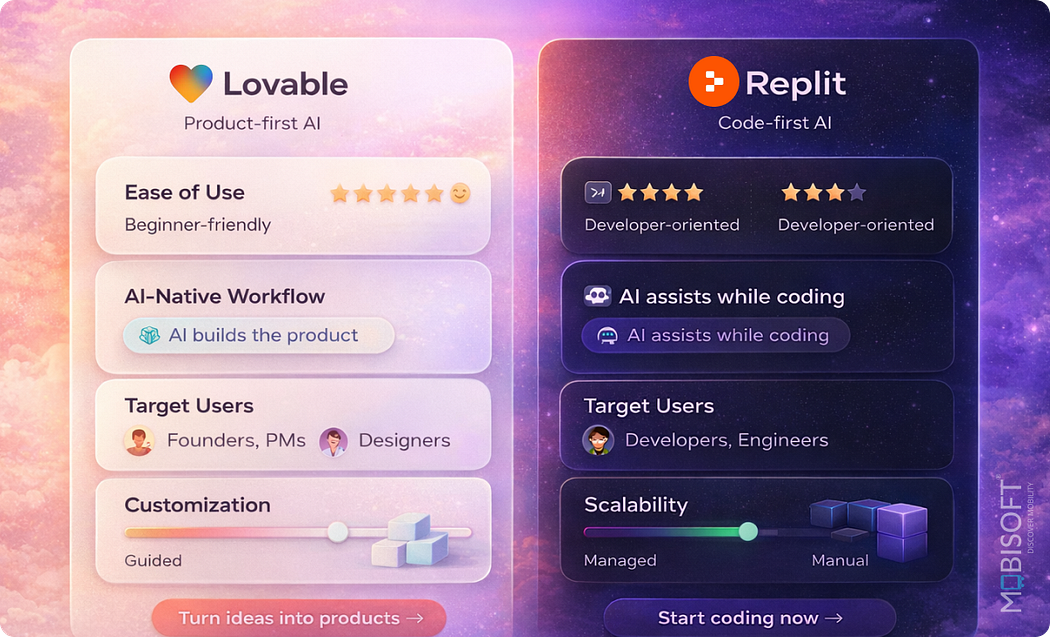
Their foundational approaches explain everything. The core philosophy of each platform dictates what you can do and how you will think when choosing an AI app builder.
Lovable: AI as the Builder
- Here, the AI is the primary agent of creation. You provide a natural language prompt describing a feature or layout. Lovable’s AI interprets this and generates the working application code.
- Your role is to guide, refine, and direct high-level outcomes. The system is designed to abstract the traditional coding process, turning specification into software in minimal steps.
- This philosophy empowers rapid conceptualization. It can feel like drafting a blueprint and watching the construction crew assemble it in real-time.
Replit: AI in the Developer Seat
- Replit works differently by providing a powerful, collaborative Cloud IDE. It is a full development environment in your browser.
- Its integrated AI, Ghostwriter, acts as a co-pilot within this familiar workspace. The developer writes the code, manages the structure, and makes decisions.
- The AI suggests, completes, and explains, but the control and explicit architecture stay with the human. This philosophy strengthens traditional development with intelligence augmentation.
This philosophical split is the first and most critical filter. It asks whether your project requires an AI that builds for you, or an AI that builds alongside you. The choice sets the tone for everything that follows: your team’s workflow, the nature of collaboration, and the ultimate architecture of your application. Choosing the right platform often starts with a clear AI roadmap and planning to align tools with long-term product goals.
Developer Experience & Onboarding: Speed vs. Control
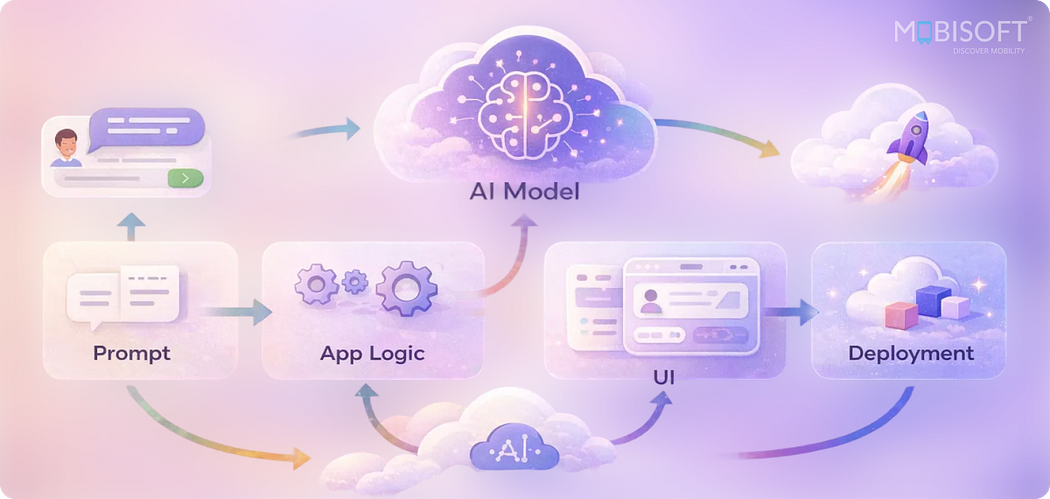
How AI App Builders Balance Fast Onboarding With Developer Control in App Development Workflows
The true impact of each platform is felt in the daily workflow when choosing between AI coding tools. One path offers a nearly frictionless launch into making. The other provides a powerful, familiar workshop where every tool remains in your hand. This difference in texture defines your team’s rhythm more than any single feature ever could when evaluating an AI app builder.
Lovable’s Speed-First Onboarding
- Lovable generates a compelling, almost surprising early momentum. You describe a concept, and a functional prototype begins to emerge.
- For rapid validation or internal tool creation, this speed is genuinely transformative. The platform cleverly handles the mundane infrastructure, letting you focus on the vision.
- When you need to understand how a feature was actually built, debugging becomes an exercise in thoughtful prompting rather than direct code manipulation.
- You learn to refine outcomes through dialogue. It’s a distinct skill, focusing on the ‘what’ over the ‘how’.
Replit’s Control-Centric Workflow
- Replit begins with familiar choices, like selecting a language or a framework. The environment provides a known developer workspace, unified in the cloud.
- Here, the AI integrates as a powerful assistant within your existing flow. It suggests functions, completes complex blocks, and clarifies logic on demand.
- The crucial difference is the retained granularity. You never lose the ability to drill down into any layer, because you are actively constructing the application together.
- This process feels like an enhanced version of traditional development. It offers speed without sacrificing depth, which many engineering teams find essential for long-term projects.
Read More: Lovable vs Replit: Which AI Tool Is Better for Building Apps Without Coding?
Comments